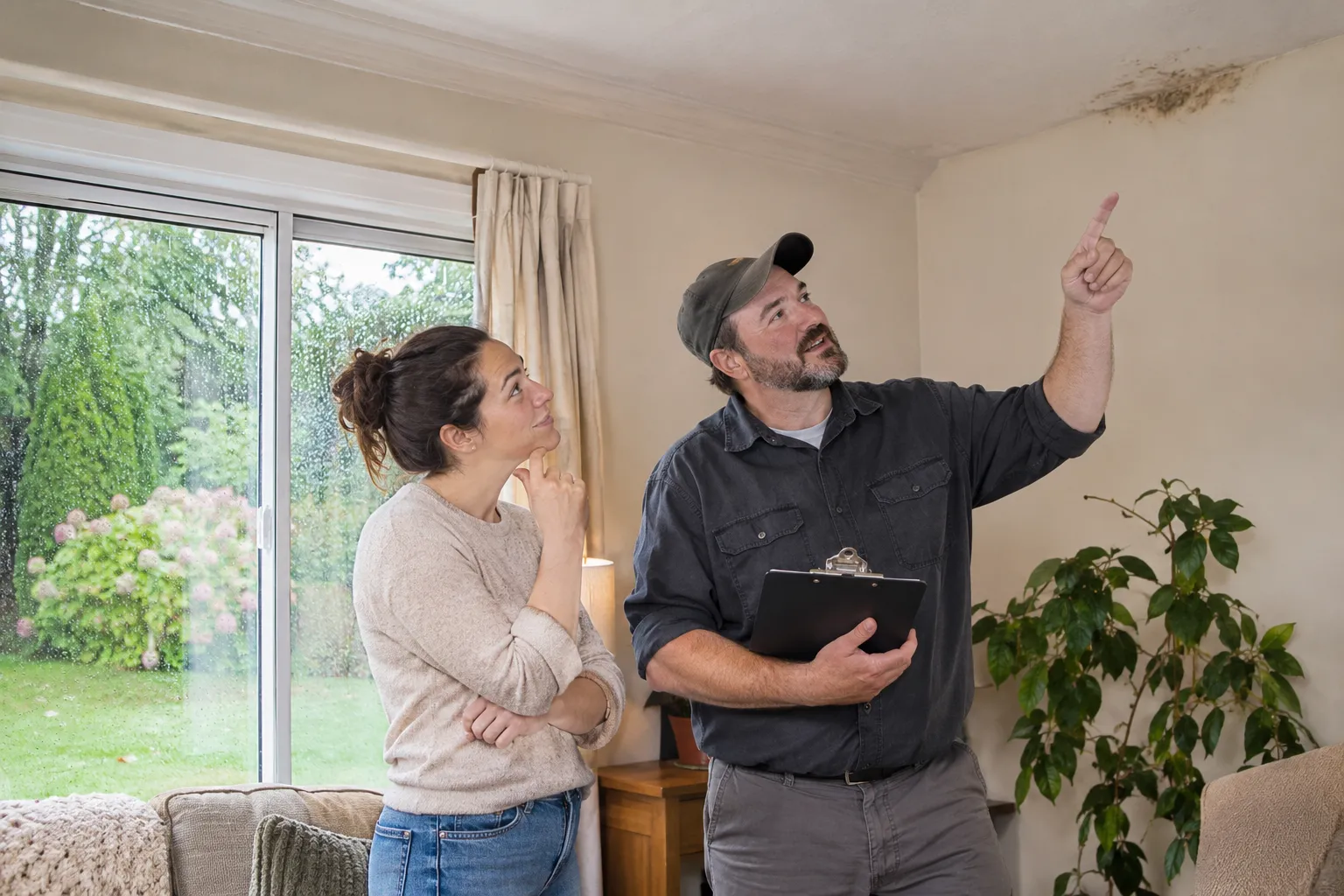
What happens when I call?
You call and speak with an independent local provider. Eugene Mold Removal does not do the work itself, so the provider you speak with sets the schedule, the scope and the price. Availability varies across the Eugene area, especially in the rainy months when many homeowners are asking at once.
To make that first exchange useful, have a few things ready:
- Photos of the affected area, taken in good light, to discuss during the call and show at the visit
- Where in the house you see it, such as a crawl space, attic, bathroom or closet
- When you first noticed it
- Any past leaks, floods or roof repairs
- Any smell you have noticed, and when it is strongest
What does the first visit look like?
Expect a walk-through. The provider will ask questions, look at the visible areas and check the likely trouble spots. In a wood-frame house that often means the crawl space, the attic, around windows, and the walls near plumbing.
Many providers bring a moisture meter, and some use thermal imaging to find damp areas behind surfaces. They may take notes and photos. Don't be shy about asking what each tool is for. A good provider is happy to explain.
This is also the time to ask about the cause. Mold is a symptom. The provider should be talking about where the water is coming from, not just the patch you can see.
Do I need testing?
Not always. Testing can help when the source is unclear, when you want documentation, or when you want a before-and-after comparison. If the mold is clearly visible after a known leak, a provider may suggest moving straight to the plan.
If samples are taken, ask what will be tested, how results are reported, and whether lab fees are included. Ask for a plain explanation of what the results mean for the work.
Call for availability (541) 579-2091
What should the written estimate say?
Before any work begins, you should have the scope on paper. Look for these points:
- The areas to be treated
- How the work area will be sealed off from the rest of the house
- Which materials will be removed and which will be cleaned
- Whether fixing the moisture source is part of the job or handled separately
- Whether rebuilding is included
- Whether a final check is planned
- How hidden damage found during the work will be handled
It is fair to ask for proof of any license or insurance your state requires for this kind of work. It is also fair to compare more than one estimate.
What happens during the work?
The details vary, but a typical job follows a clear order. The provider seals off the area so spores do not drift into the rest of the home. Damaged materials that cannot be saved, such as soaked drywall or insulation, are removed and bagged. Surfaces that can be saved are cleaned, and the space is dried. Air filtration equipment is common.
You may be asked to stay out of the work area, and sometimes to keep pets away too. Ask about the schedule, how noise and dust will be handled, and what to do if you notice something unexpected.
How do I know the job is finished?
A finished job should be checked, not just declared done. Options include a visual walk-through, a moisture reading to confirm the area is dry, or a clearance check by a separate inspector. A clearance check is useful before you close up walls and rebuild.
Rebuilding should only start after the moisture problem has been fixed. Otherwise you are covering a damp spot with new drywall and paint.
What do I do after the provider leaves?
This is the part that protects your investment. Ask the provider what likely caused the problem and what to watch for. Then build a few habits:
- Run bath and kitchen fans during use and a while after
- Keep gutters clear and downspouts pointed away from the foundation
- Check the crawl space and attic a few times a year, especially after windstorms and heavy rain
- Keep an eye on windows for condensation during cold, wet weeks
- Watch the repaired area for stains, smells or soft spots
If something returns, tell the provider promptly and ask what their policy is on follow-up. A quick look early is far easier than a big job later.
When you are ready to take the first step, call to speak with an independent local provider.
Call for availability (541) 579-2091
Keep reading